
Delivering a Custom Session Border Controller for a VoIP Provider
How we built a custom Session Border Controller (SBC) solution that protected and controlled every call flowing in and out of a communication provider's network, delivered in under five weeks.


The Challenge
A communication services provider came to us for help. They handle phone reception, switchboard, and call management for businesses in healthcare, law, and other fields, so a lot of calls run through their systems every day. They needed a custom Session Border Controller (SBC) to sit at the edge of their network, watch over every call, and connect to the software they already used. Three parts of the job were harder than the rest.
Add a checkpoint to a network that was already running
The provider's phone service was already live and busy. The new SBC had to slip into the middle of that traffic without breaking any calls. It needed to stay in the path of every call from start to finish, hide the details of the internal network from the outside world, and handle whatever call formats the existing setup used. Changes like this have to work on the first try, because there is no quiet window to test on live traffic.
Keep attackers out of a system that faces the internet
An SBC is the front door to a phone network, and that door gets attacked all the time. The platform had to stop people from stealing phone line credentials to place calls on someone else's account, block bad IP addresses, and check that callers were who they claimed to be. All of that had to happen fast enough that real calls never slowed down.
Connect to their existing software, and do it quickly
The provider needed the SBC to talk to the back office software they already ran, using APIs. And they needed the whole thing working in four to five weeks. That left no time for a long planning phase up front, so we gathered requirements, designed the system, and started building at the same time.
The Solution
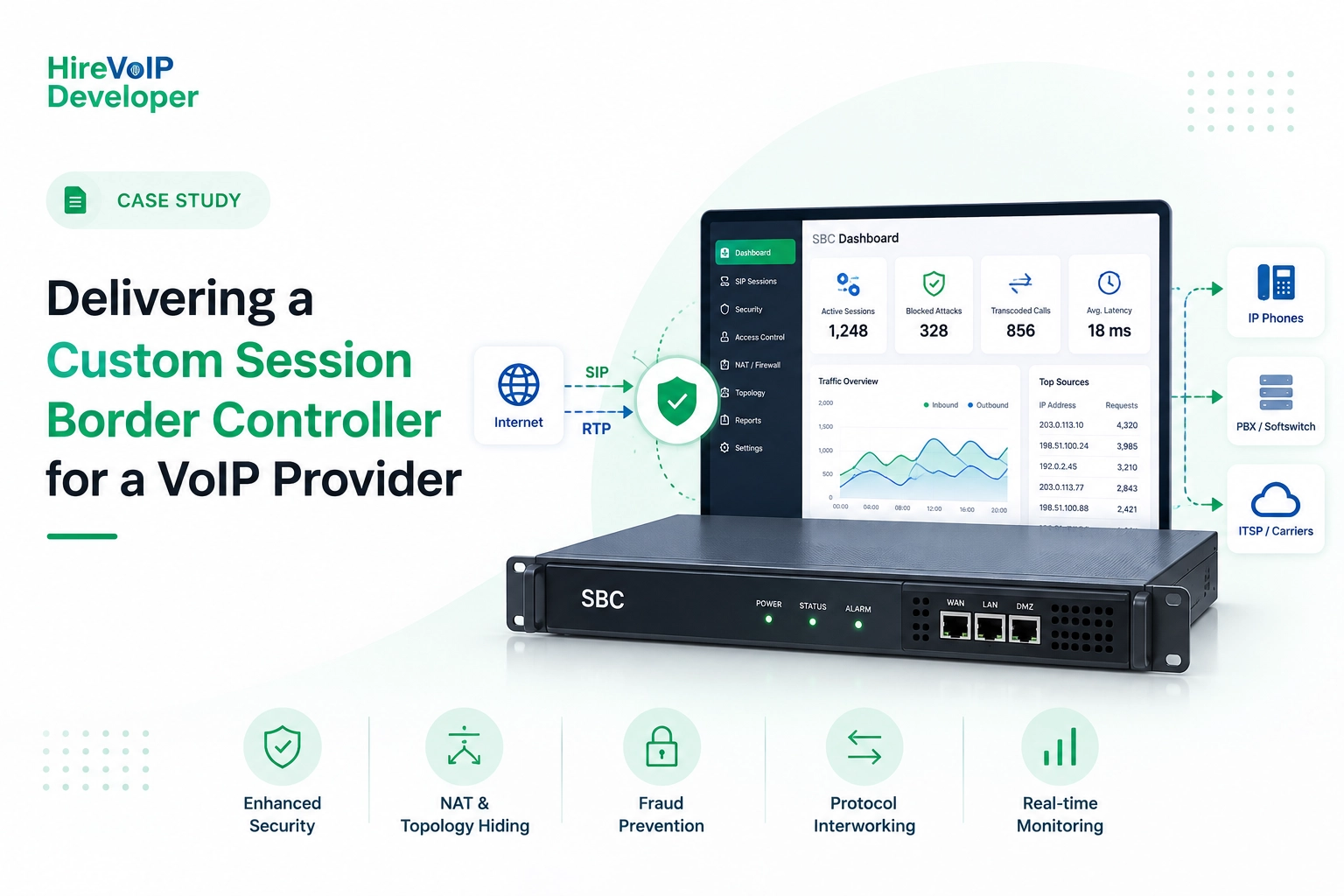
We built a custom SBC that sits at the edge of the provider's network and controls every call passing through it, with a simple control panel and APIs on top. Here is what it does, in plain terms.
It watches every call from start to finish
The SBC stays in the path of each call the whole time, so it can see and control everything, instead of dropping out once a call connects. It works on both older and newer internet address types (IPv4 and IPv6), handles several network connections at once, and speaks all the common call formats (UDP, TCP, and TLS for the call setup, RTP and SRTP for the audio). If the two people on a call use different formats, the SBC translates between them. The actual audio runs through a component called RTPEngine, which the SBC controls.
It keeps the network safe
The SBC protects the network behind it. It stops attackers from hijacking phone line credentials, blocks bad IP addresses coming from either direction, and works with Fail2Ban, a tool that bans repeat offenders automatically. It helps calls get through home and office routers, and it can check callers by password or by their IP address, whichever fits. When it blocks an IP, it emails the operations team right away, so they see an attack while it is happening.
It connects browser calls and caps the load
The SBC includes a two-way gateway between WebRTC and SIP, which is a fancy way of saying browser-based calls and regular VoIP calls can join the same system without extra software. It also puts a hard limit on how many calls run at once and how many start per second. That way a sudden rush of traffic, or one glitchy device, cannot overload the system behind it.
It gives the team control and a clear view
The provider's team manages everything through a control panel for settings, configuration, and reports, with permissions so each person only sees what they should. The SBC keeps a full record of every call (called CDRs), tracks the busiest call periods day by day, checks that the main call server is reachable, and runs in a backup setup so the system stays up if one part fails. It also connects to outside software through APIs, which is how it links to the provider's back office.

4-5 Weeks
Requirements to a deployed SBC

Web + Mobile
Live consultations from a browser or a phone

Always On
Backup setup so the edge never goes dark
Ready to scale your VoIP infrastructure?
Let our experts architect a high-performance, resilient communication platform tailored to your specific requirements.
Get Started Today